
One team for the enclosure, the board, the firmware and the app.
AI devices fail at the seams between disciplines. Our Shenzhen team covers mechanical, electrical, firmware, wireless, acoustics and test, and can build the companion app and backend in your own cloud account. Decisions that cross layers get made in one room.
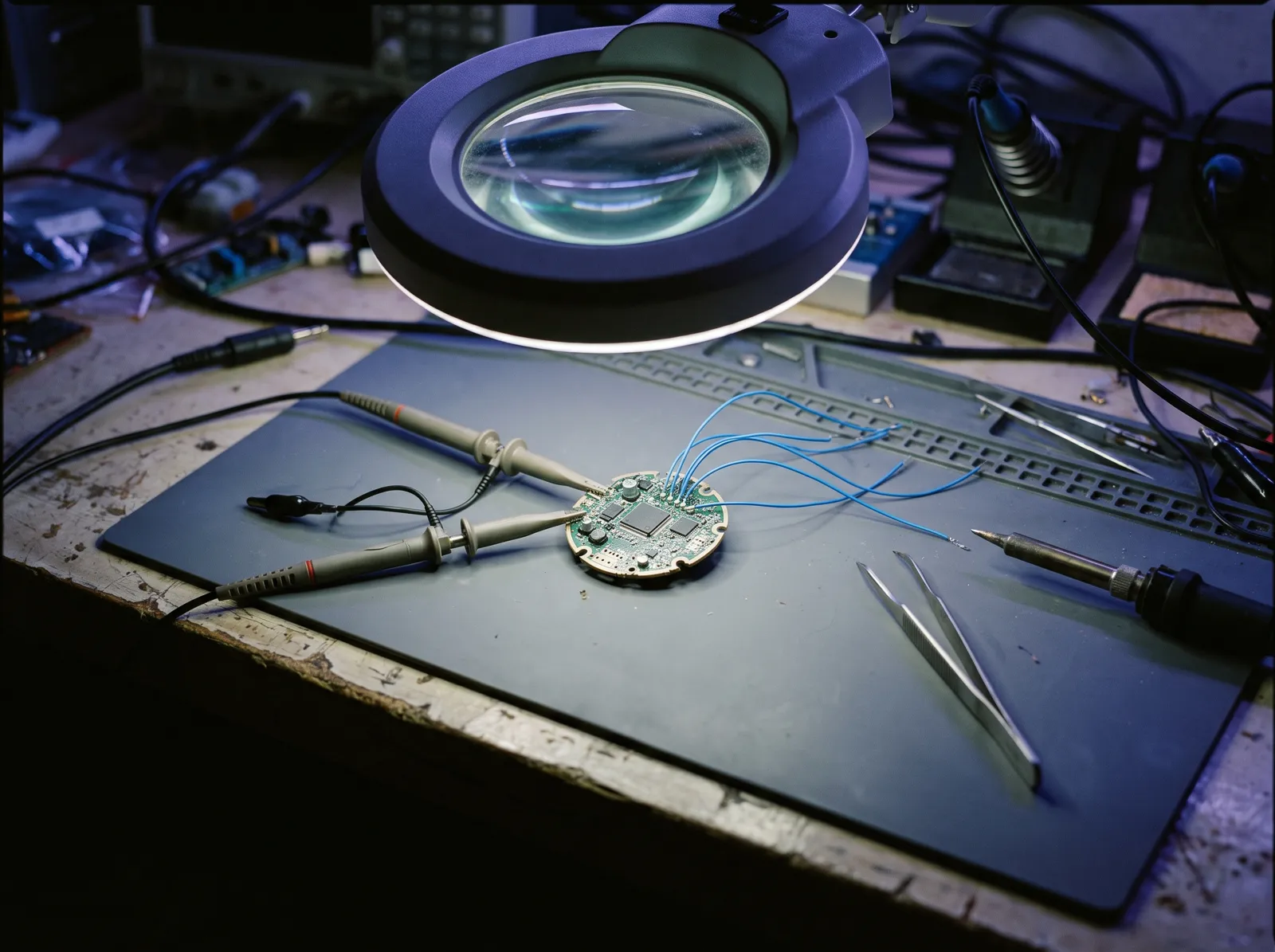 Illustration
Six disciplines, one schedule
Each of these is a deliverable with files you own, not a line item we subcontract and forget.
Mechanical & industrial design
- Enclosures for rings, pendants, clips, bands and desk devices
- Wearing surfaces, buttons, magnets and charging contacts
- Acoustic ports, gaskets and mesh for mic performance in the housing
- Drop, sweat and wipe-down behavior; tooling handoff to the factory
PCBA & power
- Schematic and layout, from single-sided rings to multi-layer HDI
- Battery, charger and fuel-gauge selection; low-power states
- Current profile measured per mode on real units
- BOM with second sources and module-origin options
Embedded firmware
- Operating states: init, active, low-power, recovery
- Sampling, recording, buffering, local storage and sync
- Secure boot, signed OTA, per-device keys
- Production test firmware and line tools
Wireless
- Bluetooth LE, Classic and LE Audio (LC3, Auracast)
- Wi-Fi for direct upload and provisioning
- LTE-M and Cat-1bis cellular with GNSS
- Apple Find My network accessories, under your MFi membership
Audio & acoustics
- Multi-mic arrays and beamforming
- Noise suppression, echo cancellation and gain control
- Codecs: Opus, LC3, AAC, aptX family, LDAC, raw PCM/WAV
- Wireless mic links with local backup recording
Test & certification
- Bring-up and hardware checks paired with firmware
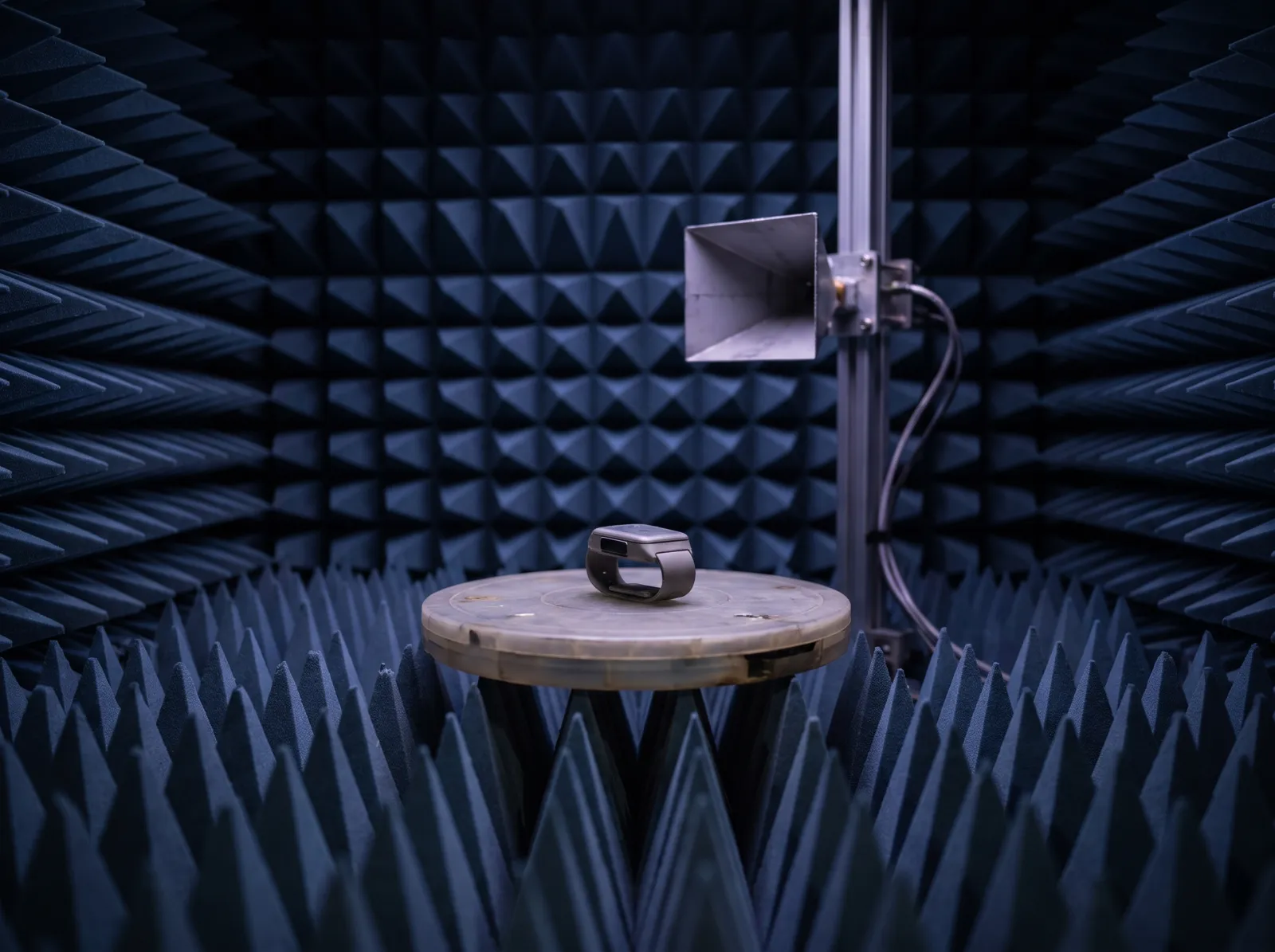
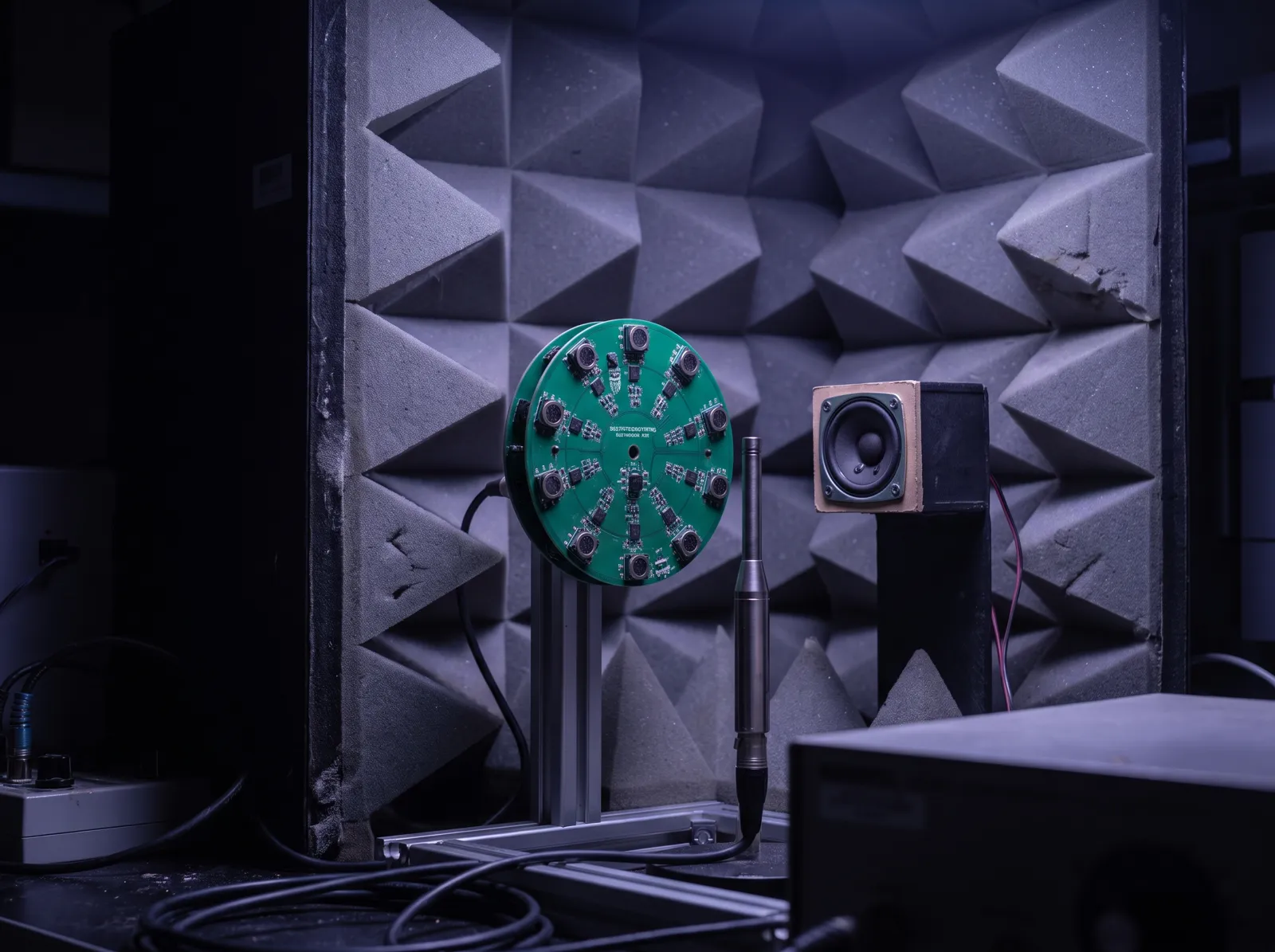
- Audio test box, RF pre-scan and reliability testing
- FCC, PTCRB, carrier and Bluetooth SIG paths planned at Gate 0
- Production test procedures and fixtures you own
Layouts we have done
A mic-array board for far-field voice pickup and the transmitter of a wireless recorder with local backup recording. Both laid out and brought up by our team.
 PCB layout
 PCB layout
Platforms we build on
Final part selection happens at Gate 0 against your runtime, size, cost and module-origin requirements. Starting on a platform we know well shortens Gates 1 and 2.
| Need | Platforms | Typical products |
|---|---|---|
| Low-power Bluetooth LE | Nordic nRF52 / nRF53 / nRF54 series; Ambiq Apollo | Rings, pendants, health bands; longest runtime per mAh |
| Bluetooth audio | Qualcomm QCC30xx and QCC51xx; JieLi (JL) audio SoCs | Wireless audio modules, headsets, USB transmitters, LE Audio and Auracast |
| Wi-Fi and on-device voice AI | Espressif ESP32-S3, C3, C5 and P4 | Desk companions, voice terminals, direct-upload recorders |
| Cellular + GNSS | LTE Cat-1bis and LTE-M modules; non-China module options on request | Trackers, senior watches, recording cards with a SIM |
| Wireless microphones | 2.4 GHz digital audio links with onboard flash | Clip-on recorders, two-person interview kits |
Part names are trademarks of their owners and are listed to describe technical experience only.
The app and backend, if you want them, in your own cloud
Many AI companies have a strong model team and no one who has shipped a BLE sync app. Pick the scope that fits. Whatever we build is deployed in your account and handed over with source.
| Scope | What you get | Who runs it after |
|---|---|---|
| Device only (default) | Firmware, device protocol spec, SDK and a test harness that uploads to your endpoint | Your team or software partner |
| Device + reference app | Above, plus a working iOS and Android app for pairing, sync, settings and OTA, with source | Your team, starting from our app |
| Full stack in your cloud | Above, plus upload API, storage, device registry and OTA service, deployed in your AWS, Google Cloud or Azure account | Your account, your keys; we hand over and can stay on for support |
Device sync that holds up
Pairing, background sync, resume after interruption, battery and storage status, and a clear rule for when a recording is safe to delete on the device.
Your models, your providers
Speech-to-text, summaries and health algorithms stay with your team or the providers you choose. We wire the upload path and measure audio quality against your model.
No China-hosted services
No Duobay server and no China-hosted cloud in the data path. Keys and credentials are yours. Source and SBOM delivered. Data sovereignty.
Numbers before opinions
Every gate ends with measurements on real units, so you decide on data.
- Bring-up. Power rails, clocks, radio and sensors checked board by board, with logs you receive.
- Power profile. Current per mode, measured on units, turned into a runtime estimate you can check.
- Audio. Mic sensitivity and frequency response in the enclosure; recordings run through your model.
- RF. Conducted power and pre-scan before formal certification, to avoid a failed lab slot.
- Data integrity. Device-to-app-to-cloud transfer tested with interruptions, full storage and low battery.
- Production test. A line procedure and fixture written with you, with per-unit logs you keep.
 Illustration
 Illustration
Engineering: common questions
Is the engineering team in-house?
Mechanical, electrical, firmware, app and test engineers work together in our Shenzhen team. Industrial design, tooling and final assembly use partner shops and factories, agreed per project and named in your contract. Team size: to be published.
Do you build on platforms not listed here?
Often, yes. The list shows the platforms our team works on. If your design needs another SoC or module, we assess it at Gate 0 and tell you what it changes for schedule and certification.
Can you make our device work with Apple Find My?
Yes, as an accessory under the Find My network program. Apple requires your company to hold the MFi membership and the product to pass Apple certification. We design the hardware and firmware to the specification and prepare the test units.
Who runs speech-to-text and summaries?
You do, or the provider you choose. We connect the device and app to your endpoint and measure audio quality against your model. We do not host recordings or transcripts on our own servers.
What source do we receive?
Mechanical CAD, schematics, layout source, Gerbers, BOM, firmware source with build instructions, app and backend source if we built them, test procedures, and an SBOM. At every paid gate, not only at the end. IP ownership.
Next step. Send us what you have: a dev-kit demo, a PCB, or a one-page description. An engineer reviews it before the call. A Duobay engineer replies within 2 business days.